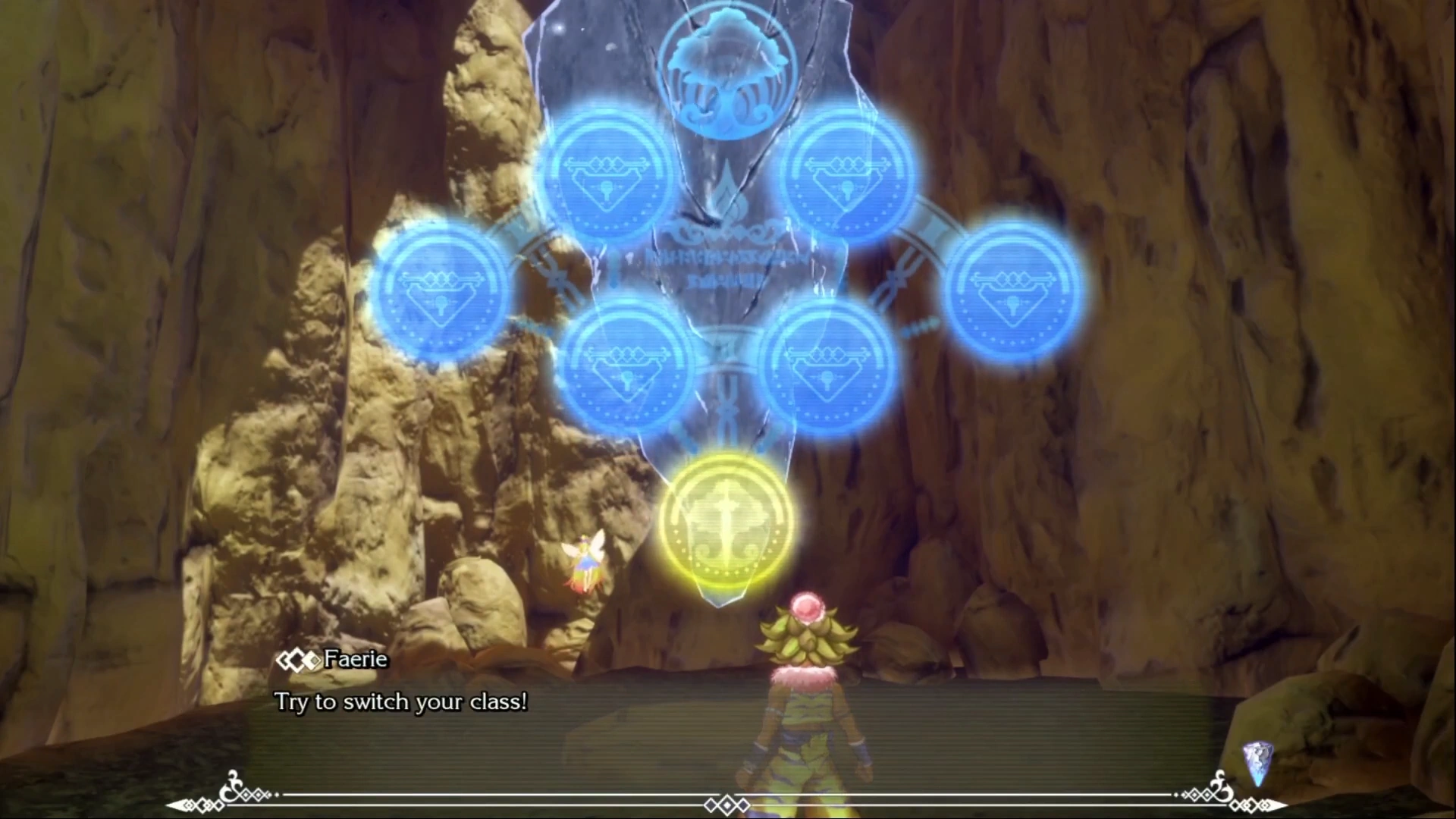

Kevin trying to change his class in the 2020 remake of Trials of Mana
The Mana series' Class Change system is a recurring integral gameplay mechanic that allows for the empowerment and progression of characters by the player's choices and preference for combat.
Overview
The Class Change System helps to give the player choices on character skill and build progression, and as well as tactical aim, combat roles, and team synergy, to allow them to play through the game as they wish in the face of increasingly more powerful enemies and the game's own level pacing as the story progresses. Various lore is also given to classes and their equipment, and to impressions of that class's overall skillset, to gain a scope of the classes' methods, approaches to fighting, and motivations that also gives appeal to players to choose based on their own preference for fighting on their own terms.
Established since Trials of Mana, the Class Change System is split into a manner of ascending and descending category branches to create a "spectrum" of alignments, with Light going upward and Dark going downward. Each branch stems to a starting class, and each branch grows out to a single secondary class, then to a selection of two final master classes. All combined, is a potential seven selections of classes; in the scope of the six main established classes, a total of 42 classes. The 2020 remake of Trials of Mana also adds 8 more final prestige classes, with two for everyone of the six potential roles for either their Light or Dark paths, allowing for a total of 50 current class choices. Nevertheless, all classes can come to team up together depending on the game, though it is established that only one of any six base roles and their associative class change branches may be used in a three party configuration.
Concerning specifications of alignments, Light classes in general focus more on healing, "orthodox" manners of fighting, defense and protection, enhancing and bolstering allies, adaptability, and the use of player skill and tactics; Dark classes in general focus more on offensive approaches, "unorthodox" manners of fighting, exploiting weakness and debilitating foes, raw power output, and being reliant on hardwired gameplay features to win. It is of emphasis that Light-Dark and Dark-Light are not the same categories, as explained below.
Analysis of Class Alignments
Light
Light classes come to give a "taste" for the foundational approaches for future Light master paths, such as providing the fundamental Heal Light spell. Light classes are meant to condition the player's tactical capabilities and to get them thinking, essentially "training" the player themselves as well to understand that the class requires handling battle on the fly and with good choices. Though derided as weak with somewhat more-to-be-desired skillsets and with not as much power as Dark, this is naturally intentional, as the class is meant to be a stepping stone to not get complacent and to move on to the greater heights of its master classes.
Class archetypes for Light are naturally given more noble and valorous traditional roles found from RPG fare, such as the Knight, the Monk, the Ranger, and the Priestess, while some ways like the Sorceress and Valkyrie draw upon the Mana series' own ingenuity, all symbolizing the will to do good and to adhere to orderly power.
Light/Light
Light-Light classes fully flesh out the prior Light class to its fullest potential, making for classes that are extremely adaptable and powerful, allowing them to work in a majority of class configurations, and are with a plethora of more subtle tricks and features that can outright turn the tides to the favor of the player. Light-Light also are more either defensive, have more stamina to keep fighting, or are capable of healing, allowing them to outlast killer attacks and endure longer to push out more damage before needing to recover, making them efficient in the long run. Light-Light also requires a high grasp of understanding by the player and to be analytical of and prepared to battle as it goes on to realize the classes' capabilities, but requires little specialization other than care and patience to see this through.
Class archetypes for Light-Light are among the classic of heroic roles, bearing themes of wholesome nature, purity, dedication to virtue, ties to the heavens, and to do good in the world, even in the face of overwhelming odds.
Light/Dark
Light-Dark classes expand upon combining the supportive features of Light classes with the exploitative features found in Dark classes, allowing them greater supportive and multifunction roles, but typically with a caveat for this specialization. The most noted feature of Light/Dark is the availability for multicast healing spells and to focus more on magic power capabilities more so than Light-Light, allowing them to maintain a strategic advantage by keeping their foes at a tactical disadvantage for a one sided battle. In turn, Light-Dark tends to trade off its physical power for defense and magic, which means that they will need to be reliant on Dark classes or items that can debuff enemy stats to level out the playing field for their advantage.
Class archetypes for Light-Dark are roles of majestic or wondrous backgrounds that are now more "morally gray" or are inclined to be more pragmatic, down to earth, or materialistic. Many Light-Dark classes also appear to be positions of worldly or political power, than the more moral and spiritual drive based classes of Light-Light, showing how such classes believe in how the results justify the means.
Dark
Like Light, Dark classes give a taste of what future classes can do, with an immediate taste of power. Their abilities allow their respective class more capability to fight back and win battles as soon as that character class changes, but as time goes on and foes get stronger, players will come to learn of their shortcomings. Like Light, Dark classes are the stepping stone to master classes, but demand more control of the player's own pace to not lead their party to a game over, as their cost for their offensive capabilities is their defense, stamina, and HP. Outside of the Cleric line, Dark classes do not offer healing capabilities. Due to their alignment, magic users also gain darkness spells, and if a day-night system is implemented, they will be encouraged to be played at night.
Class archetypes for Dark classes are of roles seen to be bent towards a foreboding way in life and to attain power by violence, conflict, and potentially forbidden means down the dark road to power, but not typically as truly evil. Dark classes also bear indication that they are of alternate methods of strength and skill, from the adoption of power and ways not of Fa'Diel that the realm lacks, to understanding of topics and subjects that are not well known or are averse to some. Thus, these classes may be perceived to only gain their Dark classification out of prejudice and discrimination.
Dark/Light
Dark-Light classes expand upon combining the offensive power of Dark classes with the tactical adaptability found in Light classes, allowing them uniquely exclusive powerful capabilities no other class is capable of. This specialization allows them to bypass the restrictions Dark classes normally tend to have, such as access to healing, multicasting, and being capable of providing support, but how they do this is the caveat for the alignment, as other party members must be in classes that help to keep the class's role focused else the specialization will spread teamwork thin and can make battles inefficient and costly. Nevertheless, Dark-Light capabilities can come to shine bright when played well and the right moves are made.
Class archetypes for Dark-Light classes bear roles with themes of those who have walked dark paths in life coming to see the light and maintain their own honor and integrity with no regrets for the path they have walked. Many classes of Dark-Light also are committed to battle and warfare as the need calls for them to fight, meaning they have confronted dark truths of the world to understand how to deal with them directly.
Dark/Dark
Dark-Dark classes gain tremendous power and uniquely exclusive abilities by augmenting the intermediate preceding Dark class with many empowering features, but do so at a larger caveat of being only offensive and without means of neither direct or indirect support for teamwork. Dark-Dark classes in turn work extremely well on divide and conquer and being independent units who are capable of wiping out opposition when enemies least expect it, but this in turn demands other classes be supportive to cover other grounds of combat or serve only the Dark-Dark class party member. Depending on the team and class layout, Dark-Dark can also be some of the more resource and monetary inefficient classes to support, as the majority of Dark-Dark classes lack any means of healing and will be forced to be reliant on item use to cover other ground if support capabilities do not exist. Thus, they require a great deal of creativity and planning to ensure that the team dynamic does not falter in the long run.
Class archetypes for Dark-Dark classes bear roles that are commonly associated with villainy and evil, making for an extreme case of moral ambiguity and interpretation that verges on alternate interpretations and not taking things at face value. As such, they may also be interpreted as anti-heroes, those who find it in themselves to engage in necessary evil and dirty work, or are more comfortable embracing their dark sides and shadows of themselves.
Class Changing
Class Changing is the process of leveling up and going forward with an alignment and class path associated to change from prior classes. Class changing is not only the act of upgrading a character by title, but deciding upon that class's methods and further expanding upon the build and potential of that character through growth.
Class Changing requires few but demanding prerequisites: a level requirement, and in some games, in the processes of master classes, the requirement of a special item known as a Class Change Item associated with the intended path.
In Sword of Mana, one must level up in a respective base class variety to gain access to that class. Master classes or more advanced base classes and their branches will likely require the logical understudy of other class trees to attain their access; in example, the Ninja Master will require the advanced study of its Thief branch to level 20 for its expertise in trickery and agile knife based fighting, while with some study of the Magician to level 5 to unlock its elemental Ninjutsu prowess, with study of another random choice base class role at level 5 to fulfill its mastery of disguise through other inconspicuous roles.
In Trials of Mana, a character can class change into their intermediate branch upon reaching level 18 and enacting the process at a Mana Stone. For their second class change into a master class, the character must be level 38 and be in possession of a Class Change Item related with their intended master class while at the special statue of the Mana Goddess within the Mana Holyland; in example, a Sorceress who wishes to be a Grand Diviner must be in possession of a Book of Arcana, which beholds the studies of the complexities of the nature of the magical world that allows them to unlock the power within, while a Ninja who wishes to be a Nightblade needs a Nighteye Die to showcase their will and skill to become a merciless assassin.
Class Varieties
Fighter Type
- Starter - Fighter
- Light - Knight
- Light/Light - Paladin
- Light/Dark - Ruling Knight/Warmaiden
- Dark - Gladiator - Warriors who seek out the meaning of the fight, and eke out proof justifying their fighting. Comes to gain more offensive strength and magic to draw out elemental weakness.
- Dark/Light - Edelfrei - Experienced fighters who have walked the earth fighting and are able to flow with the chaos of battle as with the world itself. Learns the proficiency of mastery through being at one with their weapon, and to utilize their spiritual grasp to fight in flow with the world at their side.
- Dark/Dark - Duelist - Fighters who have fallen to the way of attaining victory at any cost and fight any degree of battle, no matter how savage, brutal, or severe. Gains tremendous power to fight any foe on their own.
Monk Type
- Starter - Grappler
- Light - Monk - Martial artists who have taken virtuous vows to justified force and understanding the fighting spirit. Focuses more on "internal" ways of fighting, emphasizing the use of technique and real time adaptability.
- Light/Light - Divine Fist - Martial artists who have undergone great spiritual and martial discipline to attain lofty levels of mastery. Gains the abilities to become even more adaptable on the offense and execute powerful techniques flawlessly.
- Light/Dark - Warrior Monk - Monks who have taken their vows to understand the workings of the mind and combat through logic and study. Learns the tactics and tenets of warfare with the spiritual to apply to not only themselves but their allies who share their conviction.
- Dark - Brawler - Martial artists who aim to train their bodies to attain great strength and study how to draw out the weaknesses of their foes. Focuses more on "external" ways of fighting, emphasizing stat builds and gaining more powerful equipment.
- Dark/Light - Enlightened - Martial artists who have learned to empty their mind of emotions upon the coming of battle to become veritable living weapons. Gains the skills to sustain itself in the face of retaliation to ensure neverending onslaughts.
- Dark/Dark - Fatal Fist - Martial artists who have undertaken forbidden ways of throwing themselves into hatred and anger to grant them terrifying strength. Gains the strongest equipment and highest builds to annihilate all with their fists.
Thief Type
- Starter - Thief
- Light - Ranger - One who studies the ways of nature and the land in the face of resourcefulness. Learns to turn the tide of battles with their study of nature.
- Light/Light - Nomad - Those who have left society behind to live wandering the depths of nature. Learns ways of magic only known by the spirits of nature, and allows them to trick and outlast even the most intimidating of foes.
- Light/Dark - Rogue - Those who live in the narrow straights of survival in both the world of men and nature. Learns to wield traps and secondary off hand weaponry to strike at any given foe in any situation.
- Dark - Ninja - One who studies the art of stealth and deception in the face of battle. Learns the ways of Ninjutsu, allowing them to hinder all opposition tactfully.
- Dark/Light - Ninja Master - Those who are rightfully recognized as the strongest and masterful of Ninja. Attains mastery over the arts of Ninjutsu, and commands the ability to end combat as quickly as it starts.
- Dark/Dark - Nightblade - Those who walk the shadows and darkness of night as renegade assassins. Learns many underhanded tricks, from shadowy spells to weaken their targets, to deadly trumps capable of ridding all in an instant.
Magician Type
- Starter - Magician
- Light - Sorceress/Sorcerer - Magicians who have studied and trained rigorously to gain great magical skill and power. Unlocks powerful spells by the next level of magical power and skill by natural development.
- Light/Light - Grand Divina/Grand Diviner - Magicians who have walked the purest path of the ways of magic by understanding the magic within. Becomes all rounded and balanced in the face of all scenarios to bring about magic with not just spells, but the unexpected magic of the everyday.
- Light/Dark - Archmage - Magicians who have forged greater bonds and control over the spirits of magic to attain ultimate magical power. Excels in spellcasting technique with their gained natural magic, being capable of wiping the battlefield clean with powerful magic.
- Dark - Mysticist - Seekers of the source of all magical power in the world, delving ways potentially forbidden. Gains power and knowledge to empower their magical abilities.
- Dark/Light - Rune Seer - Scholars of ancient languages of magic to become the true embodiment of the dark arts of magic. Learns powerful magic that bends the world to their whim and devastates all with collateral damage in their wake.
- Dark/Dark - Magus - Scholars of the forbidden and forsaken, allowing them ancient methods that the world had long forgotten. Gains unmatched magical power and skill by their newfound exploits, and learns forbidden spells infamous believed to be the cause of cataclysms ages past.
Amazon/Barbarian Type
- Starter - Amazon/Barbarian
- Light - Valkyrie/Aesir - Those called by the heavens to ascend to become their sacred warriors in the earthly realm. Gains magic through their spiritual awakenings to unlock the potential within all.
- Light/Light - Vanadis/Odin - Those who have met the heavenly requirements to become the embodiments of gods and goddesses of war and love. Goes forward into battle as literal gods of war, with not just power, but endurance and fortitude, and bears the blessings of the original divinities of battle on their side.
- Light/Dark - Star Lancer - Those who dwell amongst the stars and act as their harbringers and messengers of earthly celestial wills. Excels in their spiritual powers to bless their allies and summon the deities of the stars to destroy their foes.
- Dark - Rune Maiden/Rune Knight - Those who have turned to a long lost god of war to learn the meaning of battle through carnage and conflict. Gains magic through their dark vows to enervate opposition and ensure their destruction.
- Dark/Light - Dragon Master - Those known as dragoons, being dragon knights who have learned to fight together with dragons to ascend by their own way in life. Mightily fights like the dragon in battle, and are able to summon their dragonic allies into combat.
- Dark/Dark - Fenrir Knight - Those who have fallen further into darkness, taking up the title of the evil devil wolf of legend to oversee the end of the world. Steeps themselves in demonic power and inhumane strength to prepare for the end of days, and allows them demonic magic to summon beings from the abyss and render all foes helpless before their presence.
Cleric/Sage Type
- Starter - Cleric
- Light - Priestess/Priest
- Light/Light - High Cleric
- Light/Dark - Sage
- Dark - Enchantress/Enchanter
- Dark/Light - Necromancer
- Dark/Dark - Warlock
References
| v · e · d Trials of Mana Meta
|
|---|
| Terms |
| Mana Tree · Mana Sword · Mana Stone |
| Game Mechanics |
| Abilities · Attacks · Battle Results · Bugs & Glitches · Class Change · Class 4 · CS Gauge · Magic Pot · Rabite Adornment · Rabite Slippers · Sparkle · Stats in Trials of Mana · Trap Chest · Trials of Mana Trophies · Urn |
| Menu |
| Adventure Log |
| Others |
| Trials of Mana Difficulty Level · Game Controls · Translation · Updates · Version Differences |